
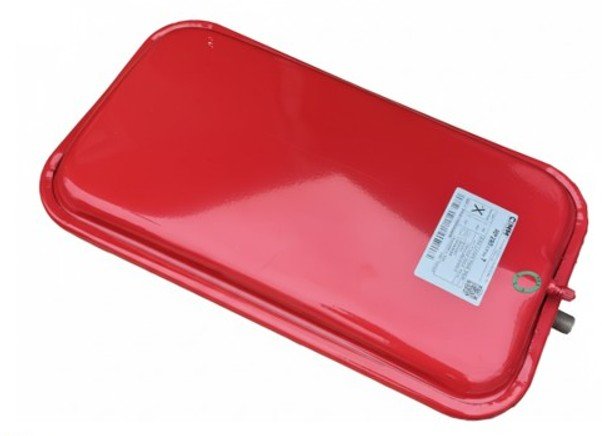
The expansion vessel is one of the most overlooked components in a boiler — but when it fails, it causes a chain reaction of pressure problems that can shut down your entire heating system. If your boiler pressure is rising too high when the heating is on and then dropping into the red when it cools, your expansion vessel is the likely culprit.
At Boiler Spares Ltd, we stock replacement expansion vessels and diaphragms for all major boiler brands. Here’s how to spot a failing vessel before it causes serious damage.
What Does an Expansion Vessel Do?
When water heats up, it expands. The expansion vessel acts like a shock absorber — it contains a rubber diaphragm and an air charge that compresses to absorb this extra volume. Without it, the pressure in your system would spike every time the boiler fires, forcing the safety valve to open and dump water outside.
A healthy expansion vessel keeps system pressure stable between 1.0 and 1.5 bar, whether the heating is on or off.
Sign 1: Pressure Rises Above 2.5 Bar When Heating Is On
This is the classic symptom. If the pressure gauge climbs into the red zone within 30 minutes of the heating starting, the vessel has lost its air charge or the internal diaphragm has split.
What happens next: The pressure relief valve (PRV) opens to protect the boiler, water drips from the outside pipe, and then the pressure drops below 1 bar when the system cools. The cycle repeats daily.
Part needed: Expansion vessel or expansion vessel diaphragm if your model allows separate replacement.
Sign 2: Pressure Relief Valve Constantly Dripping
If you see water dripping from the copper discharge pipe outside your property, the PRV has been activated. While the PRV itself might be faulty, the root cause is usually a failed expansion vessel causing repeated over-pressure events.
Important: Once a PRV has opened several times, it often fails to reseal properly and needs replacing even after you fix the vessel.
Parts needed: Expansion vessel + safety valve / PRV
Sign 3: Pressure Drops to Zero Overnight
A split diaphragm inside the vessel allows system water to fill the air side. Over time, this water escapes through the Schrader valve (the car-tyre style valve on the vessel), causing pressure to drop gradually.
Quick test: Press the Schrader valve briefly. If water comes out, the diaphragm has definitely split.
Part needed: Expansion vessel
Sign 4: Cold Radiators or Noisy System
When the vessel fails, pressure spikes can force air into the system. This creates cold spots at the top of radiators and gurgling or banging noises from the pipework.
Fix: Replace the vessel, then bleed all radiators and re-pressurise.
Sign 5: Boiler Locks Out with High Pressure Errors
Modern boilers monitor pressure electronically. If the vessel fails, you may see error codes such as:
Table
| Boiler Brand | Error Code |
| Baxi | E117 (water pressure too high) |
| Worcester Bosch | A8 (water pressure too high) |
| Vaillant | F.12 or F.13 |
| Ideal | F1 (low pressure after cooling) |
How to Test Your Expansion Vessel
- Turn off the boiler and let the system cool
- Check the pressure gauge — it should read 1.0–1.5 bar
- Find the Schrader valve on the vessel (usually underneath or at the side)
- Press it briefly with a tyre pressure gauge
- Healthy vessel: Reads 0.5–1.0 bar of air pressure
- Failed vessel: Reads zero, hisses water, or drips
Can I Replace an Expansion Vessel Myself?
Yes — but it’s heavy work. Expansion vessels weigh 3–8kg when full and require:
- Draining the heating system (or at least lowering the pressure)
- Unscrewing the old vessel from the pipework
- Recharging the new vessel to the correct air pressure before fitting
- Refilling and re-pressurising the system
If you’re not confident draining the system, call a heating engineer. The vessel itself is straightforward to fit — the labour is in the draining and refilling.
Flat vs Round Expansion Vessels
Table
| Type | Common In | Notes |
| Flat (rectangular) | Combi boilers, wall-mounted units | Space-saving, usually built into the boiler casing |
| Round (cylindrical) | System boilers, external mounts | Larger capacity, easier to access |
Make sure you order the correct size. The vessel capacity (usually 6, 8, 10, or 12 litres) should match your system size. Check your boiler manual or the label on the old vessel.
Shop Expansion Vessels
At Boiler Spares Ltd, we stock flat and round expansion vessels for Baxi, Worcester Bosch, Vaillant, Ideal, Glow-worm, Alpha, and more. All vessels are pressure-tested and come with fast UK delivery.
- Flat expansion vessels
- Round expansion vessels
- Expansion vessel diaphragms
- Safety valves & PRVs